
The IAB Transparency and Consent Framework (TCF) is the advertising industry's standardized method for managing user consent across publishers, advertisers, and Consent Management Platforms under GDPR. This guide explains how IAB TCF works, its key requirements, the compliance concerns raised by Data Protection Authorities, and how Secure Privacy's approach — using Google Consent Mode Advanced — offers a more user-centric alternative for GDPR-compliant consent management.
Who Is This For?
Website owners and publishers evaluating whether to implement IAB TCF or an alternative consent management approach
Compliance officers assessing the GDPR compliance risks associated with IAB TCF
Ad tech and marketing teams managing consent signals for advertising and analytics vendors
What Is the IAB Transparency and Consent Framework (TCF)?
The IAB TCF sets a standardized method for cooperation between online publishers, advertisers, and Consent Management Platforms (CMPs) to meet GDPR transparency and consent requirements. It enables consent signals to be shared between first parties, third parties, and CMPs — so that each vendor in the ad tech ecosystem receives the correct consent status for each user.
Key Players in the IAB TCF Ecosystem
Publishers: Website owners who display advertising and collect user data for analytics and personalization.
Vendors: Third parties — such as advertisers, ad networks, and analytics providers — that process user data under publisher consent.
CMPs: Services like Secure Privacy that help publishers collect, record, and signal user consent in compliance with the IAB TCF standard.
Note: Several Data Protection Authorities (DPAs) have raised formal concerns about whether IAB TCF fully complies with GDPR — including enforcement actions and legal proceedings against IAB Europe directly.
Key Considerations and Compliance Risks of IAB TCF
Limited user control: The framework's vendor-centric design may limit website owners' direct control over what user data is collected and by whom — with consent decisions delegated to a vendor-managed list.
Transparency and UX trade-offs: IAB TCF's strict UI requirements often result in large, text-heavy cookie banners that can overwhelm visitors and reduce consent quality.
Compliance uncertainties: Multiple DPAs have challenged IAB TCF's GDPR adherence:
IAB TCF Banner and Preference Center Requirements
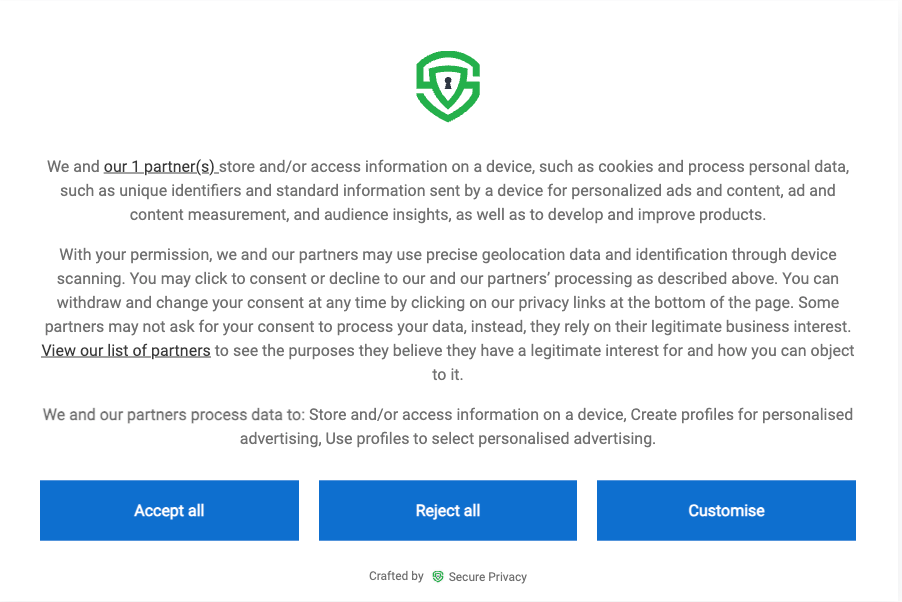
IAB TCF mandates specific UI and functionality for cookie banners to ensure uniform consent collection across all publishers using the framework. Required elements include:
A prominent, separately displayed consent banner
Clear explanation of data storage and processing purposes
Information about all third-party vendors and their standard processing purposes
A link to the full IAB vendor list
These requirements make TCF-compliant banners substantially larger and more text-heavy than standard cookie consent banners. Modifications to the banner design may risk non-compliance with TCF certification requirements.
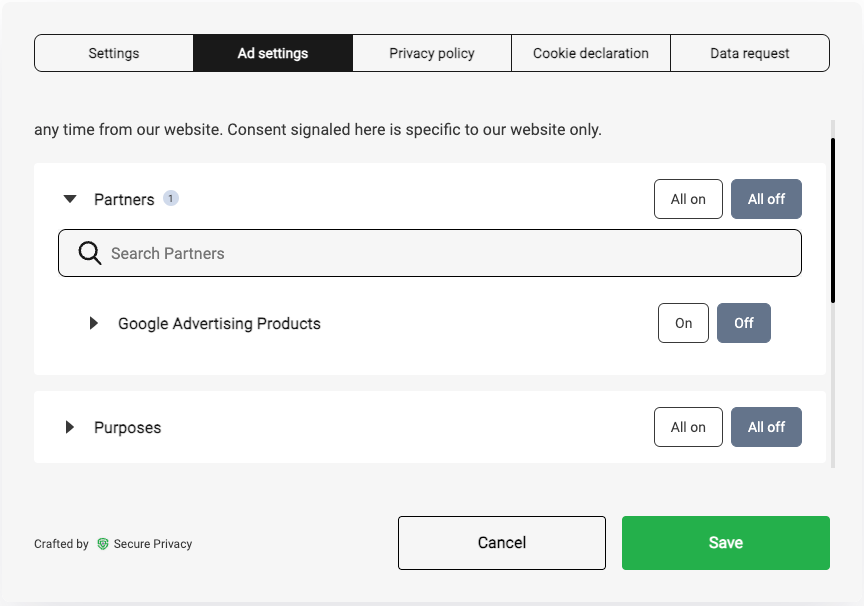
The preference center — accessible via the banner's Customize button — includes two tabs:
Ad Settings: Visitors can control consent for individual listed vendors and specific processing purposes.
Settings: Secure Privacy's standard multi-category cookie consent controls — covering Essential, Analytics, Marketing, and other categories.
Secure Privacy's User-Centric Approach to GDPR Compliance
Secure Privacy offers a GDPR-compliant consent management approach that does not depend on IAB TCF — prioritizing user clarity, website owner control, and adaptability to evolving regulations:
Full control for website owners: Direct management of cookie deployment and consent options — without delegating control to a vendor-managed framework.
Streamlined consent UX: Intuitive, concise cookie banners that maintain transparency without overwhelming visitors with vendor lists and processing purpose text.
Google Consent Mode Advanced integration: Future-proof GDPR compliance and conversion measurement capability — independent of IAB TCF certification.
Adaptable to changing regulations: Secure Privacy's framework updates as privacy laws evolve — covering GDPR, CCPA, LGPD, and 50+ other regulations.
Conclusion: IAB TCF vs. Secure Privacy's Approach
IAB TCF provides a standardized framework for the ad tech ecosystem — but its vendor-centric design, complex UI requirements, and unresolved GDPR compliance questions present real risks for publishers. Secure Privacy's approach — using Google Consent Mode Advanced rather than IAB TCF — prioritizes user privacy, website owner control, and robust GDPR compliance without the compliance uncertainties associated with the IAB framework.
Frequently Asked Questions
Why are IAB TCF cookie banners so large and text-heavy?
IAB TCF mandates that all certified CMPs display specific information about vendors, processing purposes, and user rights — and these requirements are strictly enforced. The resulting banners are necessarily more complex than standard GDPR consent banners. If the verbose banner design is affecting your user experience and conversion rates, Secure Privacy's streamlined consent approach — using Google Consent Mode instead of IAB TCF — provides a cleaner, more user-friendly alternative without sacrificing compliance.
Does IAB TCF guarantee GDPR compliance?
Not unconditionally. While IAB TCF is designed to facilitate GDPR compliance, multiple supervisory authorities — including the Belgian DPA — have found that the framework itself violates GDPR in specific respects. Organizations using IAB TCF should stay current with DPA guidance and enforcement decisions, and consider whether their specific implementation meets GDPR requirements beyond TCF certification alone.
Can I use Secure Privacy without implementing IAB TCF?
Yes. Secure Privacy supports both IAB TCF and non-TCF consent management approaches. For publishers who do not need TCF for advertising purposes, Secure Privacy's Google Consent Mode Advanced integration provides a fully compliant, simpler alternative — without the UI complexity or compliance risks associated with TCF.