When a GDPR auditor asks "who changed your cookie consent banner settings last month — and when?" you need an answer in seconds, not hours of frantic email archaeology. The same urgent question surfaces during internal security reviews, when unexpected changes appear in your privacy configuration, or when you're trying to establish accountability across a team that shares access to your consent management platform.
Many privacy teams work around this gap by maintaining manual change logs in spreadsheets or relying on email threads — approaches that are error-prone, inconsistently updated, and never available at exactly the moment they're needed. Other consent management tools either omit activity tracking entirely or bury it behind expensive enterprise tiers.
Secure Privacy includes a built-in Audit Log — also called the Audit Trail — as a standard account management feature. Every action taken inside your account is automatically captured: who did it, what they changed, which domain was affected, and precisely when it happened. No manual logging, no add-ons required.
By the end of this guide you'll know how to access the Audit Log, understand every column in the activity table, filter records by date or domain, and build a regular review habit that keeps your organisation continuously audit-ready.
Who Should Use the Secure Privacy Audit Log?
Privacy & Compliance Officers who need a tamper-proof activity history to satisfy GDPR, ePrivacy, and CCPA audit requirements.
Website Owners & Marketing Teams managing cookie consent banners across one or more domains and needing visibility over team-level changes.
IT & Security Teams investigating unauthorised or unexpected modifications to privacy management settings.
Agencies administering Secure Privacy accounts on behalf of multiple clients and maintaining a clean change record for each.
Prerequisites
An active Secure Privacy account with at least one domain configured.
Account-level access (Admin or Owner role) — team members with restricted roles may have limited visibility.
How to Access the Audit Log in Secure Privacy
Step 1 — Log in to your Secure Privacy account
Open secureprivacy.ai and sign in with your account credentials.
Step 2 — Open the Account area
Click "Account" in the top navigation bar to enter your account management settings.
Step 3 — Select the Audit Log tab
Click the "Audit Log" tab. The full activity history for your account will load in a sortable, filterable table.
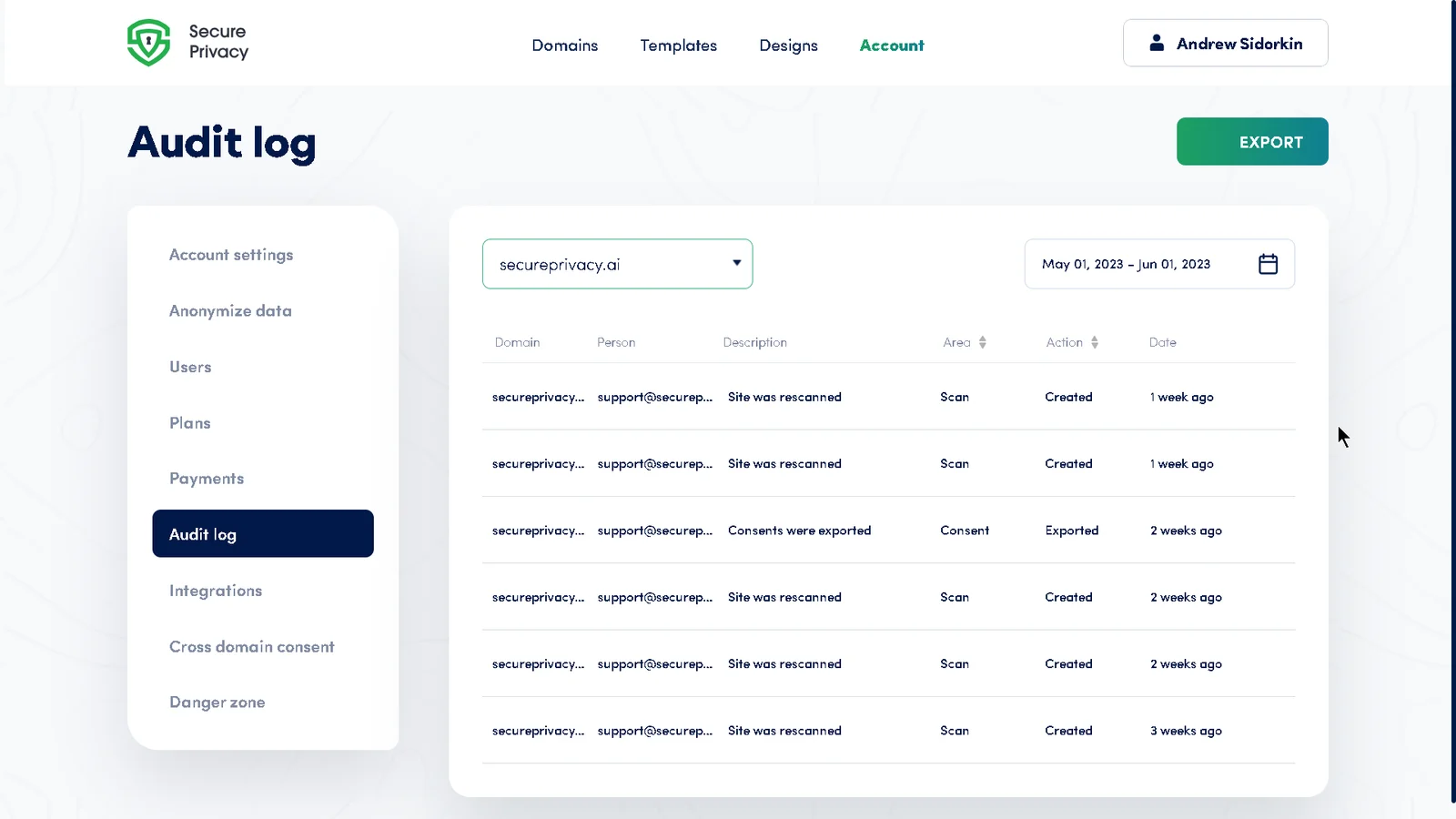
The Audit Log tab inside Secure Privacy Account settings, showing a full table of timestamped activity records.
Understanding the Audit Log Table Columns
Each row in the Audit Log represents a single recorded action. The table contains the following columns:
Domain
The domain associated with the recorded activity — useful when your account manages multiple sites.
Person
The user account responsible for performing the action, providing clear individual accountability.
Description
A concise summary of the activity or change made — for example, "Updated consent banner colour" or "Added new domain."
Area (sortable)
The specific module or section of Secure Privacy where the action took place — such as Consent Banner, Domains, or Account Settings. Click the column header to sort by area.
Action (sortable)
The type of operation performed: created, updated, or deleted. Sort this column to quickly group all deletions or creations in a given period.
Date
The calendar date the action occurred. Hover over the date to reveal the precise timestamp, which is essential for detailed compliance reporting.
Filtering the Audit Log by Date or Domain
By default, the Audit Log displays activity across all domains in your account. Use the available filters to narrow results to a specific domain, time period, or both — ideal for scoped compliance investigations or client reporting.
Filter by Date
Use the calendar dropdown widget to select a specific date or date range. Only audit log entries falling within that window will be shown, making it straightforward to scope activity to a particular compliance period or incident timeframe.
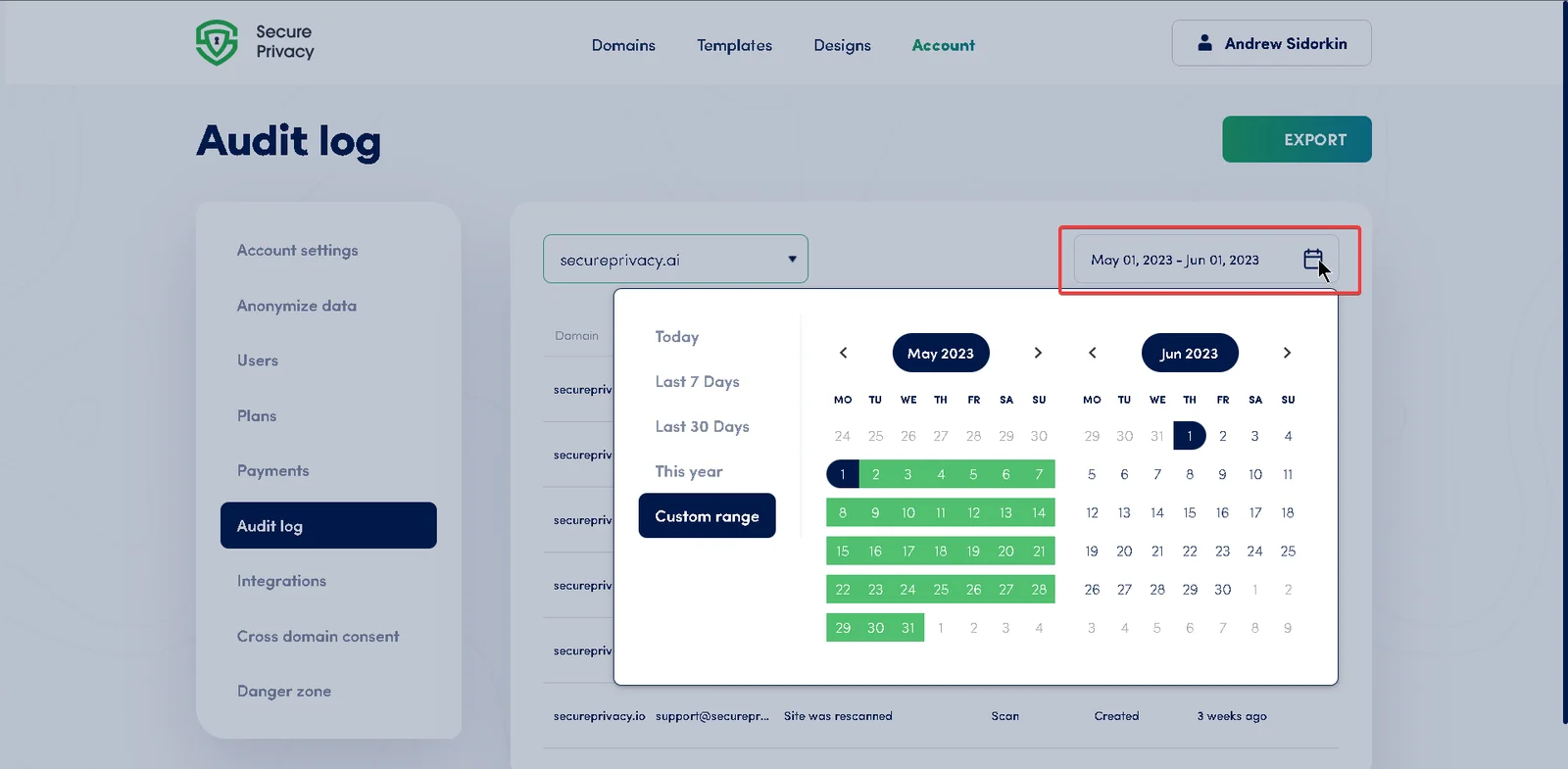
The date range filter in the Secure Privacy Audit Log — select any custom period to scope the activity history.
Filter by Domain
If your Secure Privacy account manages multiple domains, use the domain search field to filter audit log entries by a specific domain name. Type the domain and click it in the results to apply the filter — all other domains' activity will be hidden, giving you a clean, domain-specific change record.
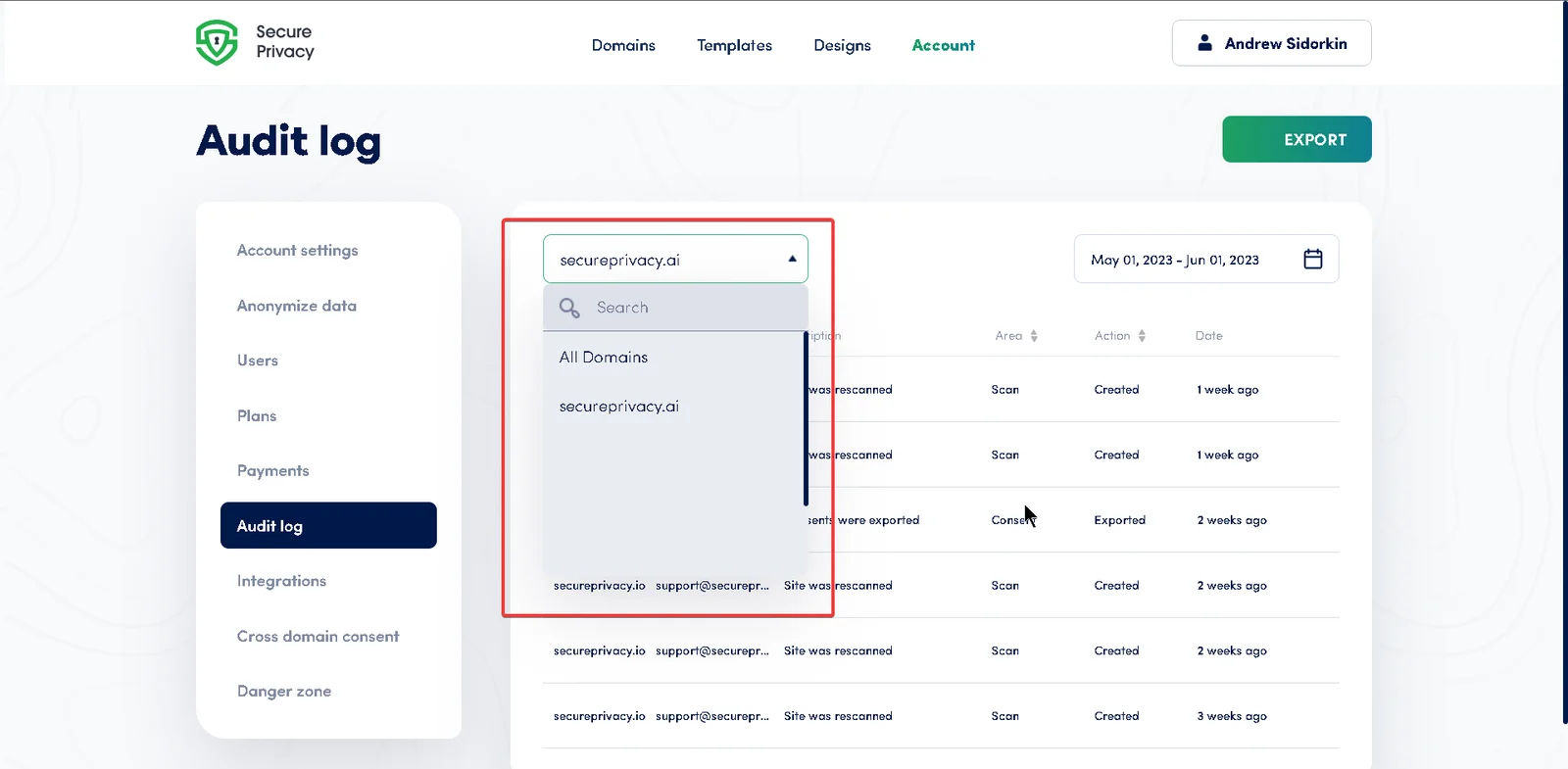
The domain filter in the Secure Privacy Audit Log — type a domain name to isolate that site's full activity history.
Best Practice: Review Your Audit Log Regularly
Schedule a monthly Audit Log review as part of your GDPR compliance routine. Look for unexpected deletions, configuration changes made outside normal working hours, or actions by users who shouldn't have modified specific settings. This proactive habit closes accountability gaps before they become audit findings.
Troubleshooting the Audit Log
The Audit Log tab is not visible
The Audit Log is an account-level feature. If you cannot see the tab, check that you are logged in with an Admin or Owner role. Team members with limited permissions may not have access — contact your account owner to adjust role settings.
No entries appear after applying a filter
Confirm the selected date range overlaps with the period when activity occurred, and that the correct domain is selected. Clearing both filters will restore the full activity history so you can verify that records exist before narrowing results.
Timestamps show the wrong time zone
Dates in the Audit Log are displayed in your account's configured time zone. If you see unexpected times, hover over the date to view the full timestamp and cross-reference with your local time zone offset.
Frequently Asked Questions
Does Secure Privacy have an audit trail for GDPR compliance?
Yes. Secure Privacy includes a built-in Audit Log (Audit Trail) that automatically records every change made in your account — who did it, what was changed, and when — making it straightforward to demonstrate accountability during a GDPR audit.
Can I see who changed my cookie consent banner settings?
Yes. The "Person" column in the Audit Log identifies the specific user account responsible for each action, and the "Description" column summarises what was changed — including modifications to consent banner configuration.
How long does Secure Privacy retain audit log history?
Retention periods may vary by plan. For specific details about how long your Audit Log history is stored, contact the Secure Privacy support team at [email protected].
Can I export or download the Audit Log?
Export functionality may depend on your account plan. Reach out to [email protected] for guidance on exporting audit trail data for compliance reporting.
Does the Audit Log track changes across multiple domains?
Yes. By default the Audit Log shows activity across all domains in your account. You can then use the domain filter to isolate the activity history for any individual domain.
Related Articles
Managing User Roles and Permissions in Secure Privacy[?]
Managing Multiple Domains in One Secure Privacy Account[?]
Need Further Help?
If you have questions about the Audit Log or need assistance interpreting activity records for a compliance review, the Secure Privacy support team is ready to help. Reach out at [email protected].