
Your Secure Privacy account is the control centre for cookie consent banners, GDPR compliance settings, and privacy policies across every website you manage. A compromised account doesn't just mean lost access — it can mean altered consent records, broken compliance, and regulatory exposure. Yet most account security problems come down to the same two gaps: a password that hasn't been changed in months, and no second layer of verification stopping an attacker who already has it.
Many teams rely on a single strong password or a shared login, assuming that's enough. It isn't — especially for a platform that touches your organisation's legal compliance posture. The good news is that Secure Privacy makes it straightforward to close both gaps: you can update your personal information, rotate your password, and enable two-factor authentication (2FA) via SMS in a few minutes, all from one place.
By the end of this guide you will have fully secured your Secure Privacy account — with verified contact details, a fresh password, and 2FA activated so every future login requires both your password and a one-time code sent to your phone.
Who Is This Guide For?
This article is for anyone who owns or administers a Secure Privacy account, including:
Website owners and webmasters managing GDPR or CCPA cookie consent banners
Privacy or compliance officers who need audit-ready account security
Developers and agencies managing Secure Privacy on behalf of clients
Any user who has recently changed their email address or phone number and needs to update their account details
Prerequisites
An active Secure Privacy account with login credentials
Access to your current password (required to change it)
A mobile phone number capable of receiving SMS, if you plan to enable 2FA
Accessing Your Account Settings
All personal information, password, and two-factor authentication settings are managed from the same account menu. To get there:
Step 1 — Log in to Secure Privacy
Visit the Secure Privacy website and sign in using your credentials.
Step 2 — Open the account settings menu
In the top-left corner of the dashboard, click your name. This opens the account settings menu where all profile, security, and authentication options are found.
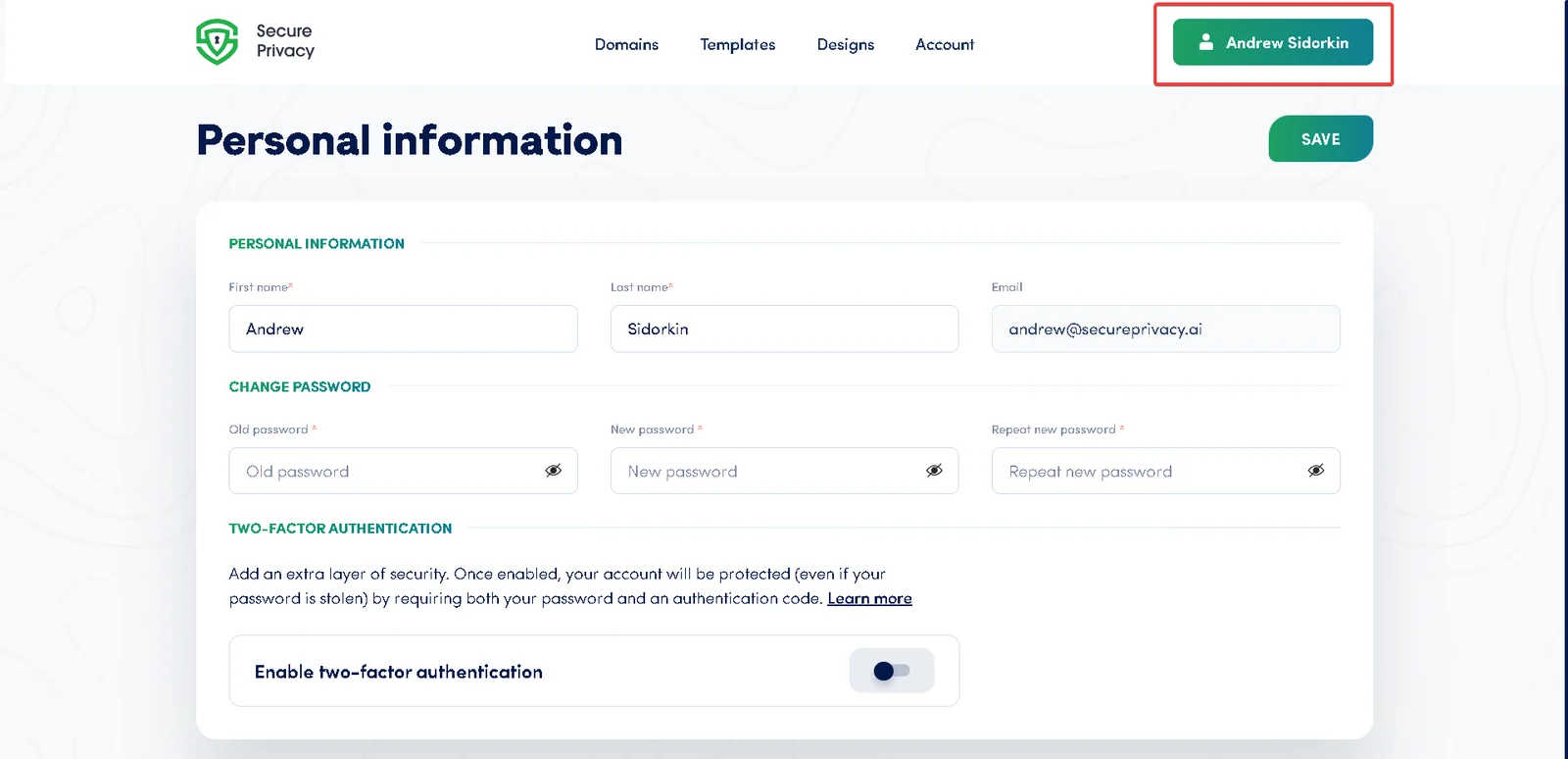
Click your name in the top-left corner to access account settings, password, and two-factor authentication options.
How to Update Your Personal Information
Your personal information — name and email address — is used for account identification, login, and platform communications. Keeping it current ensures you receive important compliance notifications and can always recover account access.
Navigate to the Personal Information page within account settings and update the following fields:
First name
Enter your first name as you want it to appear in the platform.
Last name
Enter your last name.
Provide your current, active email address. This is also your login identifier, so keep it up to date if your address changes.
Click Save to apply your changes.
How to Change Your Secure Privacy Account Password
Regularly rotating your password is one of the simplest ways to maintain account security — particularly important for a platform that controls your website's compliance configuration. To update your password, fill in these fields in account settings:
Old password
Enter your current password to verify your identity before making changes.
New password
Choose a new password that meets Secure Privacy's password requirements. Use a mix of letters, numbers, and symbols for the strongest protection.
Repeat new password
Re-enter your new password exactly to confirm there are no typos.
Click Save to apply your new password. You will use it on your next login.
How to Enable Two-Factor Authentication (2FA) in Secure Privacy
Two-factor authentication adds a critical second layer of security to your account. Even if your password is ever exposed in a breach, an attacker cannot sign in without also having access to your mobile phone. For any account managing GDPR cookie consent and privacy settings across live websites, enabling 2FA is strongly recommended.
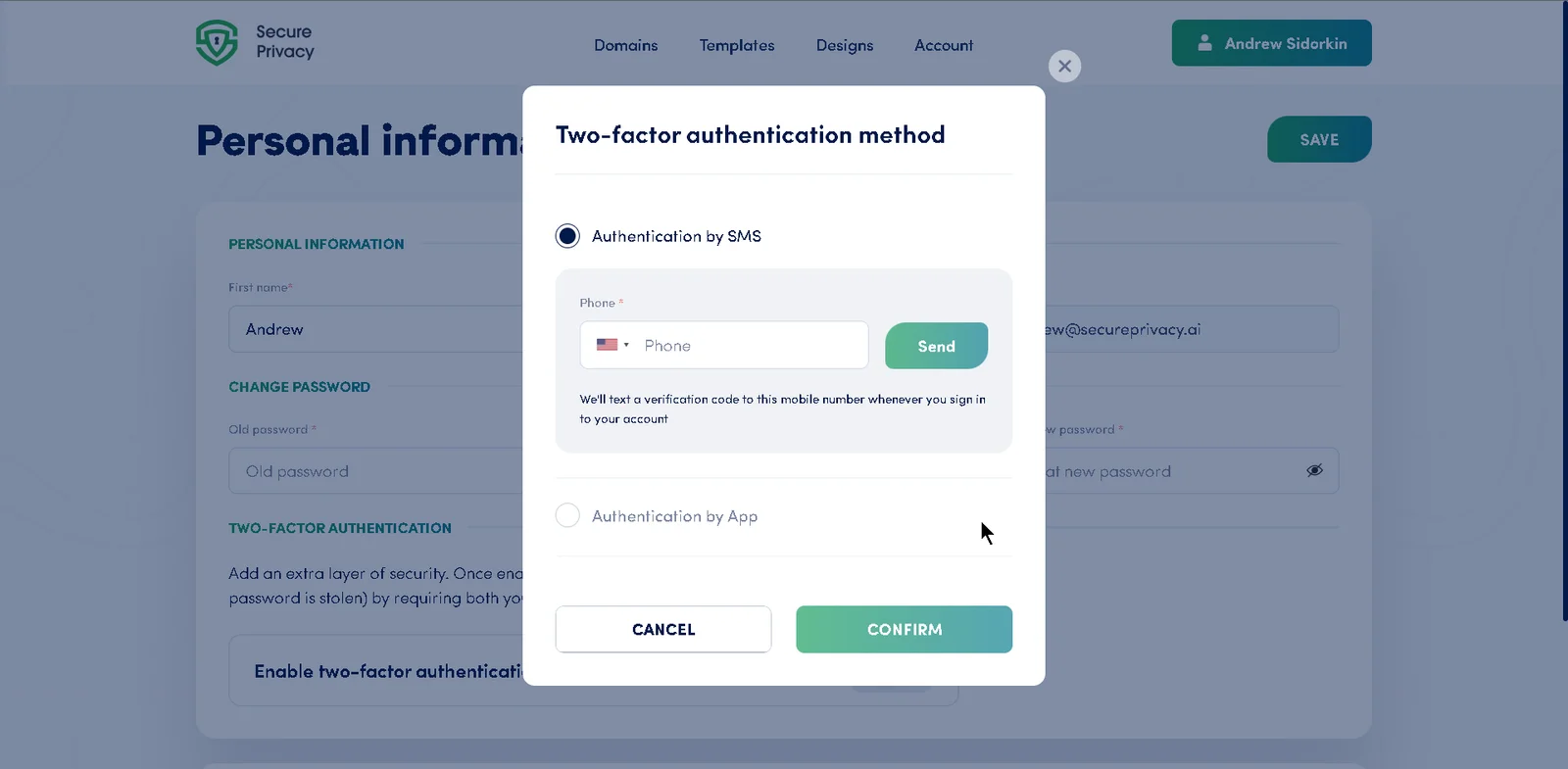
The Two-Factor Authentication section in Secure Privacy account security settings, with the SMS verification method available.
Step 1 — Enable the 2FA toggle
In your account settings, locate the Two-Factor Authentication section and toggle the switch to the enabled position.
Step 2 — Choose your authentication method
A confirmation popup will appear showing the available Two-Factor Authentication Methods. Select your preferred method. Currently available:
Authentication by SMS — a one-time verification code is sent to your registered mobile number each time you sign in.
Step 3 — Enter your mobile number
If you selected SMS authentication, provide your mobile number in international format. This is the number that will receive your verification codes at every login.
Step 4 — Confirm and activate
Confirm your selection to activate two-factor authentication. From this point on, every Secure Privacy login will require both your password and a one-time SMS code.
What Happens After You Enable 2FA
Once two-factor authentication is active on your Secure Privacy account:
Every login attempt will prompt you for a one-time SMS code after your password is accepted.
Even if someone obtains your password, they cannot access your account without physical access to your registered phone.
You can disable 2FA at any time by returning to the security settings and toggling it off — though this is not recommended for accounts managing live compliance configurations.
Troubleshooting Common Account Settings Issues
I'm not receiving my SMS verification code
Check that the mobile number saved in your account settings is correct and entered in full international format (e.g. +44 for UK numbers). If the number is correct, check that your phone has signal and is not in airplane mode, then request a new code. If the issue persists, contact Secure Privacy support.
My old password isn't being accepted when I try to change it
Passwords are case-sensitive. Check that Caps Lock is off and that you are entering the password exactly as set. If you cannot remember your current password, use the password reset option[?] on the login page before returning to this process.
Changes to my personal information aren't saving
Ensure all required fields (first name, last name, email) are filled in before clicking Save. If the email field contains an address already in use by another account, the save will be blocked — use a unique email address.
Frequently Asked Questions
Does Secure Privacy support two-factor authentication?
Yes. Secure Privacy supports two-factor authentication via SMS. Once enabled in your account security settings, you will receive a one-time verification code on your registered mobile number each time you sign in.
How do I change my password in Secure Privacy?
Open account settings by clicking your name in the top-left corner of the dashboard. Enter your current password, then your new password twice in the password fields, and click Save.
What authentication methods does Secure Privacy's 2FA support?
Currently, Secure Privacy offers SMS-based two-factor authentication. A one-time code is sent to your mobile number at each login.
Can I update my email address in Secure Privacy?
Yes. Go to the Personal Information section in your account settings, update the email field, and click Save. Use an active, unique email address you control, as it is also your login identifier.
Why should I enable 2FA on my cookie consent management account?
Your Secure Privacy account controls GDPR consent banners, cookie policies, and compliance data across your websites. Enabling 2FA ensures that even if your password is compromised, an attacker cannot access or alter your compliance settings without also having your phone.
Related Articles
How to Manage Your Subscription and Billing Settings[?]