
Summary: A well-designed Preference Center reinforces your brand identity and gives users a clear, trustworthy way to manage their consent choices. This guide walks through all of Secure Privacy's Preference Center design and customization options — including color configuration, button styling, preview modes, and custom CSS — so you can create a consent experience that is visually consistent with your website and compliant with GDPR requirements.
Who Is This Guide For?
- Website administrators and designers customizing the visual appearance of their Secure Privacy Preference Center
- Developers applying custom CSS to align the Preference Center with their brand's design system
- Marketers and compliance managers ensuring a consistent, professional consent experience across their site
How to Access the Preference Center Design Editor
To begin customizing your Preference Center design in Secure Privacy:
- Log in to your Secure Privacy account
- Navigate to the Design section in the top toolbar of your dashboard
- Select the design template you want to preview or modify
- Proceed to the Preference Center subsection
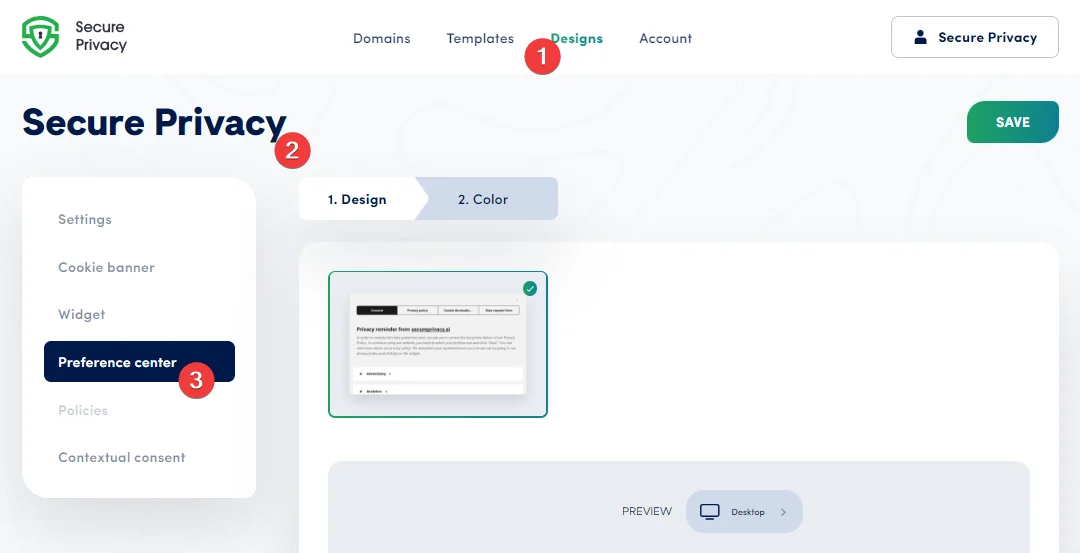
Preference Center Design Configuration
Within the Preference Center section, the Design tab is your primary control panel for visual customization. It currently includes a preview mode and custom CSS capability, with additional configuration options planned for future releases.
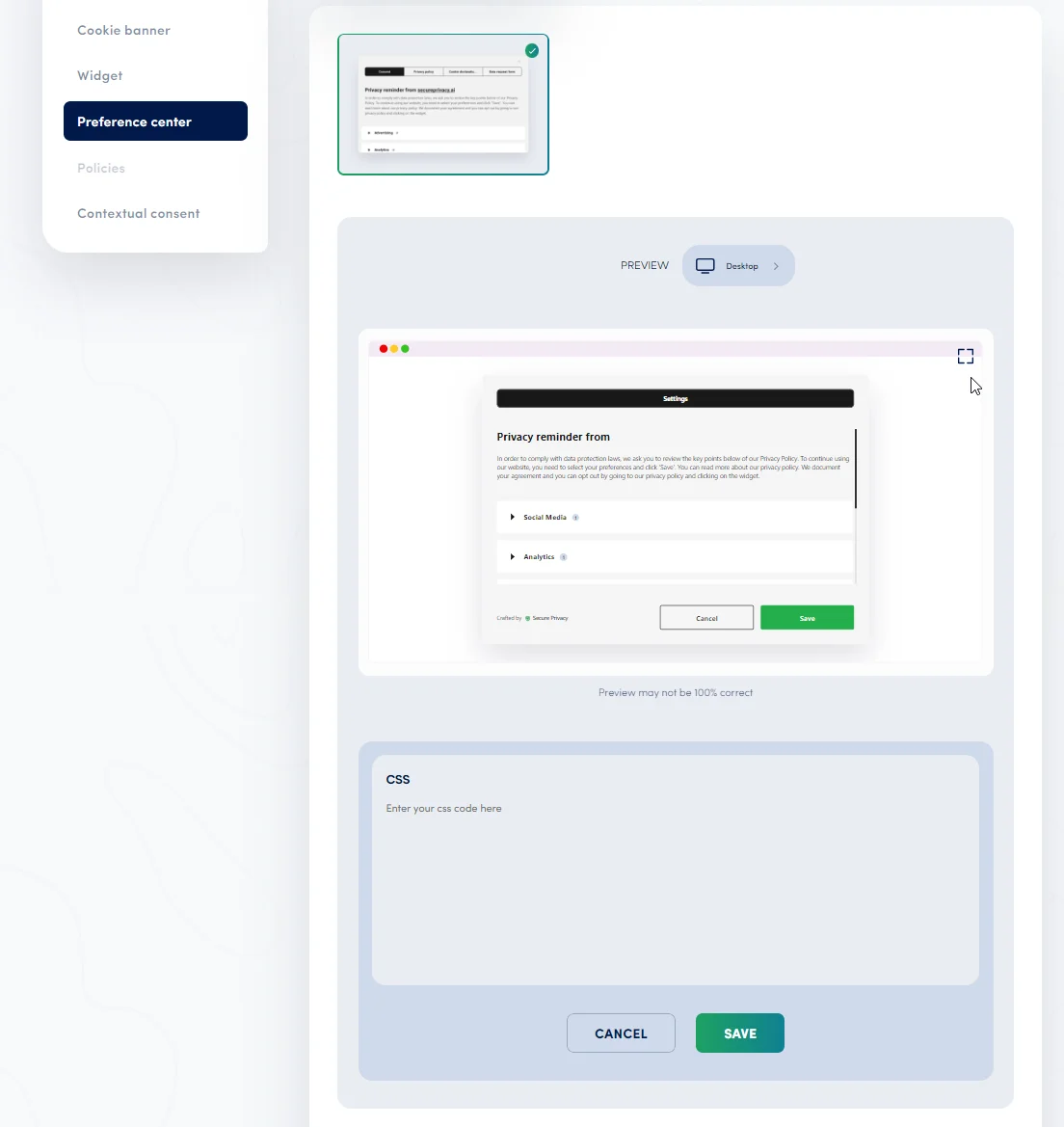
Preview Across Desktop, Tablet, and Mobile
The Preview feature lets you see how your Preference Center will appear across different device screen sizes — desktop, tablet, and mobile — before publishing any changes. Note that the preview is approximate; switch to full-screen view for the most accurate representation of how your users will experience the page.
Custom CSS for the Preference Center
The Custom CSS option gives developers complete control over Preference Center styling beyond the visual editor. Use it to apply brand-specific color schemes, typography, spacing, margins, and layout adjustments — ensuring your Preference Center is visually consistent with the rest of your website.
Key benefits of using Custom CSS for your Preference Center include:
- Full control over design elements not exposed in the visual editor
- Design consistency across your consent UI, cookie banner, and site-wide brand system
- Ability to import and apply custom web fonts (e.g., via Google Fonts)
For guidance on writing Custom CSS for Secure Privacy components, see How to Add Custom CSS for Improved Design and Branding.
Preference Center Color and Button Settings
Click Next Step on the Design tab to open the Color tab, where you can configure every color element of your Preference Center. Each sub-section controls a distinct visual layer of the page.
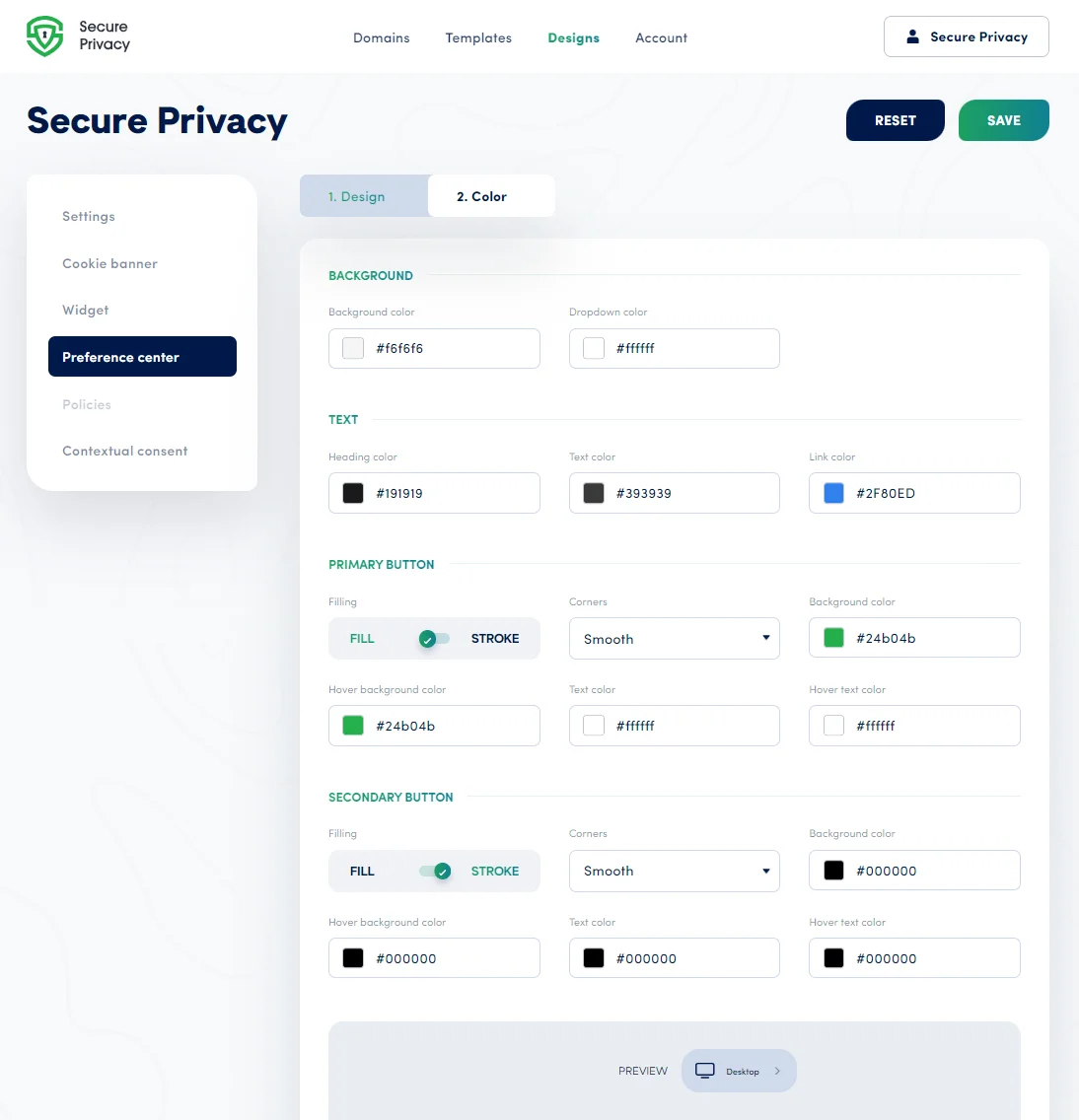
Background Color
Choose a background color and dropdown background color that aligns with your brand's color scheme. Consistent background colors create a seamless visual connection between the Preference Center and your main website design.
Text Colors: Heading, Body, and Links
The Text section controls three color elements:
- Heading color — the color for section titles and headings within the Preference Center
- General text color — body copy and descriptions
- Link color — clickable links such as your Privacy Policy
Choose colors that complement your brand palette while maintaining strong readability. WCAG 2.1 AA requires a minimum contrast ratio of 4.5:1 between text and its background. Verify your choices using the WebAIM Contrast Checker.
Reset to Default Settings
If you are not satisfied with your customizations, click Reset to revert all color settings back to Secure Privacy's defaults. This provides a safe fallback if design changes produce unexpected results.
Best Practices for Designing a Branded, Accessible Preference Center
Use your brand color palette: Apply your site's primary and secondary colors consistently across backgrounds, text, and buttons for a cohesive experience.
Verify contrast ratios: All text must meet WCAG 2.1 AA's 4.5:1 contrast ratio. Test every color combination before publishing.
Keep button labels clear: Use plain, action-oriented language on consent buttons (e.g., "Save Preferences," "Accept All," "Reject All") — avoid ambiguous labels.
Test on real devices: The built-in preview is a guide, not a guarantee. Test the live Preference Center on actual mobile devices to verify usability.
Audit after custom CSS changes: Run an accessibility check with Axe Tools or WAVE by WebAIM after applying any custom CSS to catch unintended accessibility regressions.
Frequently Asked Questions (FAQ)
Where do I find the Preference Center design settings in Secure Privacy?
Go to Design in your Secure Privacy dashboard toolbar, select your template, and navigate to the Preference Center subsection. The Design tab and Color tab contain all visual customization options.
Can I apply custom CSS to the Preference Center?
Yes. The Custom CSS option within the Preference Center Design tab allows you to write CSS targeting Secure Privacy's Preference Center components. This is useful for typography, spacing, layout adjustments, and any styling beyond what the visual editor exposes.
What contrast ratio should my Preference Center text meet?
WCAG 2.1 AA requires a minimum contrast ratio of 4.5:1 for normal text. Use the WebAIM Contrast Checker to validate your heading, body text, and link color selections against their backgrounds.
Can I reset my Preference Center design to defaults?
Yes. The Reset button on the Color tab reverts all color configurations back to Secure Privacy's default settings — useful if your customizations have produced unexpected visual results.
Do Primary and Secondary buttons need to look different from each other?
They can be visually differentiated, but neither should be so prominent that it unfairly steers users toward one consent option. Under GDPR, all consent choices must be presented with equal clarity and accessibility. Use fill vs. stroke styling to distinguish them while keeping visual weight balanced.
Conclusion
Secure Privacy's Preference Center design editor gives you precise control over every visual element of your consent UI — from background and text colors to button styles and custom CSS. A well-designed Preference Center builds user trust, strengthens brand identity, and ensures your consent experience is both accessible and GDPR-compliant.