
Drupal is a powerful, open-source content management system (CMS) known for its flexibility and modular architecture. Since 2001, it has evolved into a favored platform for complex, scalable websites used by governments, enterprises, educational institutions, and communities. Its modular structure allows extensive customization through contributed modules and themes — making it an ideal CMS for integrating a consent management platform (CMP) like Secure Privacy for GDPR and cookie consent compliance.
This guide walks you through installing and configuring the Secure Privacy Drupal module to enable cookie consent management on your Drupal site.
- New to Secure Privacy? Please follow the entire guide.
- Already onboarded? You can skip directly to the "Downloading the Drupal Module" section.
Who Is This For?
- Drupal developers and administrators integrating Secure Privacy
- Website owners seeking compliance with GDPR, CCPA, and other privacy regulations
- Technical teams setting up a cookie consent management system (CMP) on Drupal
Getting Started with Secure Privacy
- Activate your email address and log in to your Secure Privacy account.
-
After login, you will see an onboarding screen similar to this:
- Select Drupal.
- Copy the displayed Secure Privacy script code and save it for later.
- Keep this tab open and open a new tab to continue with the Drupal module installation.

Downloading the Secure Privacy Drupal Module
-
Download the
Secure Privacy Drupal Module
and save it locally.
- Extract the downloaded archive on your local machine.
-
Upload the extracted
secure_privacyfolder to your Drupal site'smodulesdirectory using FTP or your server's file manager.- For Drupal 8, 9, and 10, use the recommended paths:
/modules/contrib/or/modules/custom/
- For Drupal 8, 9, and 10, use the recommended paths:
- Set correct file permissions (
755for folders and644for files).
Installing the Secure Privacy Module in Drupal
- While logged in as Administrator, go to the Configuration tab.
-
Scroll to the System section and click on Secure Privacy.
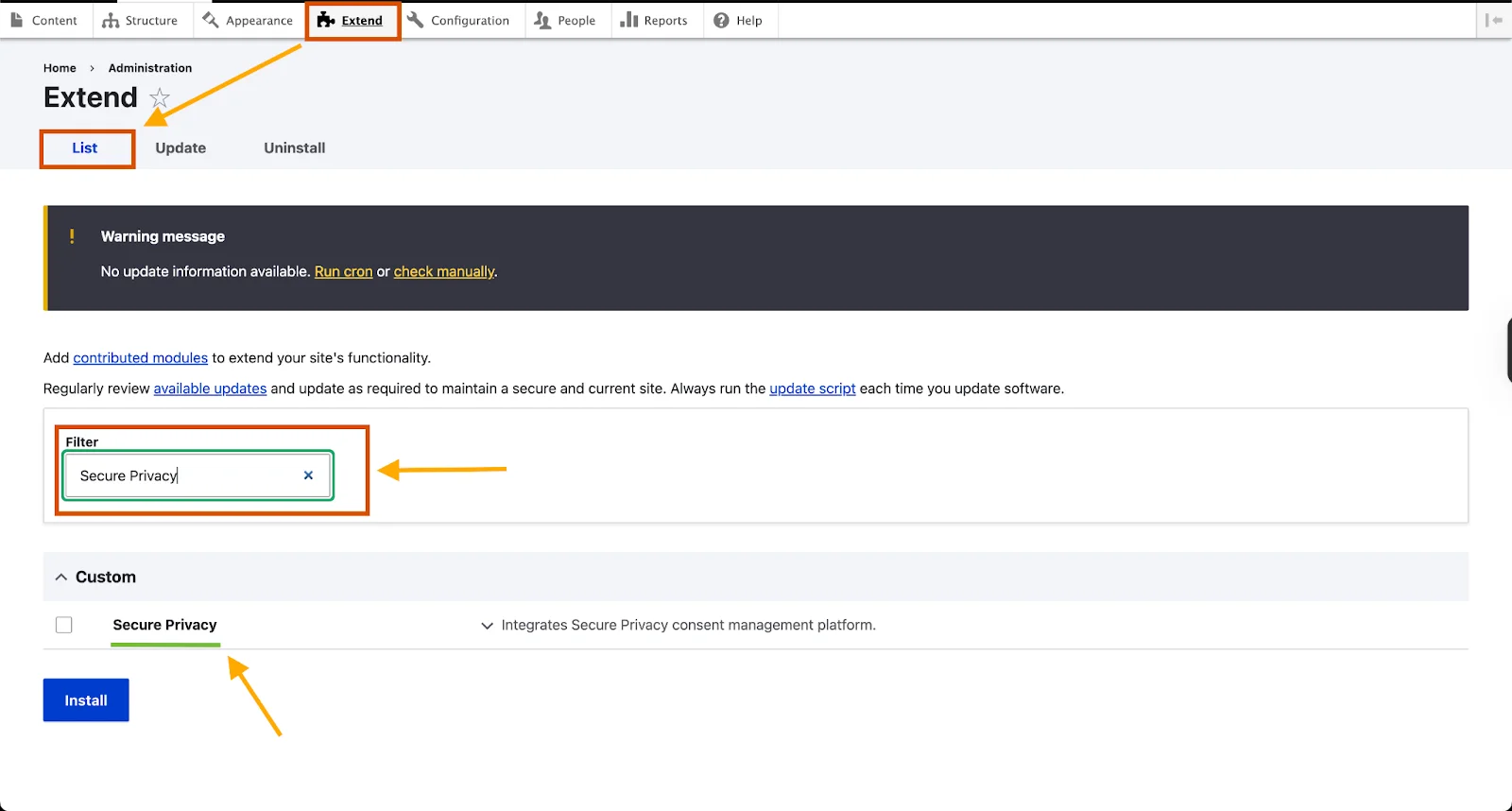
- Enable the Secure Privacy module by selecting it and clicking Install.
Configuring the Secure Privacy Drupal Module
- While logged in as Administrator, go to the Configuration tab.
-
Scroll to the System section and click on Secure Privacy.
-
On the configuration screen, paste the Secure Privacy installation script you copied earlier into the Secure Privacy Script text box.
- Check Enable Secure Privacy and click Save configuration.


Complete the Secure Privacy Setup
- Return to the Secure Privacy onboarding tab.
- Click Test Installation.
-
A toast notification confirming successful installation will appear at the bottom left of the screen.

Common Issues & Fixes
The Secure Privacy module is not showing up in the Extend list. What should I do?
Verify the secure_privacy folder is correctly uploaded to the
modules/contrib/ or modules/custom/ directory and that file
permissions are set correctly (755 for folders, 644 for files).
I cannot see the configuration screen for the Secure Privacy module.
Ensure the module is enabled in the Extend menu and that you are logged in with administrator privileges.
The Secure Privacy cookie consent script does not load on my website.
Double-check that the correct installation script has been pasted into the Secure Privacy Script field and that the configuration has been saved with Enable Secure Privacy checked.