
Summary: This guide explains how to verify that Google Consent Mode is correctly implemented and working on your website using Secure Privacy. You'll learn how to identify the gcs parameter in Google Analytics network requests, compare tag behavior with and without consent, and use browser tools like the Consent Mode Inspector and window.dataLayer to confirm consent signals are firing correctly.
Who Is This Guide For?
Website administrators and developers verifying their Google Consent Mode integration after setup
Technical marketers and analytics managers checking that Google Analytics and Google Ads tags respond correctly to user consent
Compliance professionals confirming GDPR-compliant tag behavior before go-live
Before You Begin
Google Consent Mode must already be implemented on your site (via Basic or Advanced Mode)
You have access to your browser's Developer Tools (Chrome DevTools recommended)
Your Secure Privacy consent banner is live and rendering correctly on the page
How Google Consent Mode Changes Google Analytics Tag Behavior
Before testing, it helps to understand what changes once Google Consent Mode is active. By default, Google Consent Mode blocks Google tags from creating or reading any cookies until the user grants consent—similar to fully blocking the script, but with one key difference: a cookieless "collect" ping is still sent to Google Analytics.
Previously, without Consent Mode, Secure Privacy blocked the entire Google Analytics script when a user hadn't consented, meaning no network requests were made. With Google Consent Mode active, a lightweight collect API call is sent immediately—but it contains a special gcs parameter that signals the user's consent status to Google.
Quick Reference: gcs Parameter Values
G100— Consent Denied (default state, no cookies set)G101— Analytics consent GrantedG111— All consent types Granted
How to Check Google Consent Mode Is Working: No Consent State
To verify correct behavior before a user consents, follow these steps:
Open your browser's Developer Tools (F12 or right-click > Inspect).
Clear all cookies for the site (Application tab > Storage > Clear site data).
Reload the page without interacting with the consent banner.
Go to the Network tab and filter for
collect.
You should see a collect request sent to Google Analytics. This confirms Google Consent Mode is active. Unlike a non-Consent Mode implementation, this request fires even without consent—but no cookies are created.

The Google Analytics collect request visible in the Network tab before user consent is given — a sign that Google Consent Mode is active.
To inspect the request in detail, click the collect call and review its parameters:
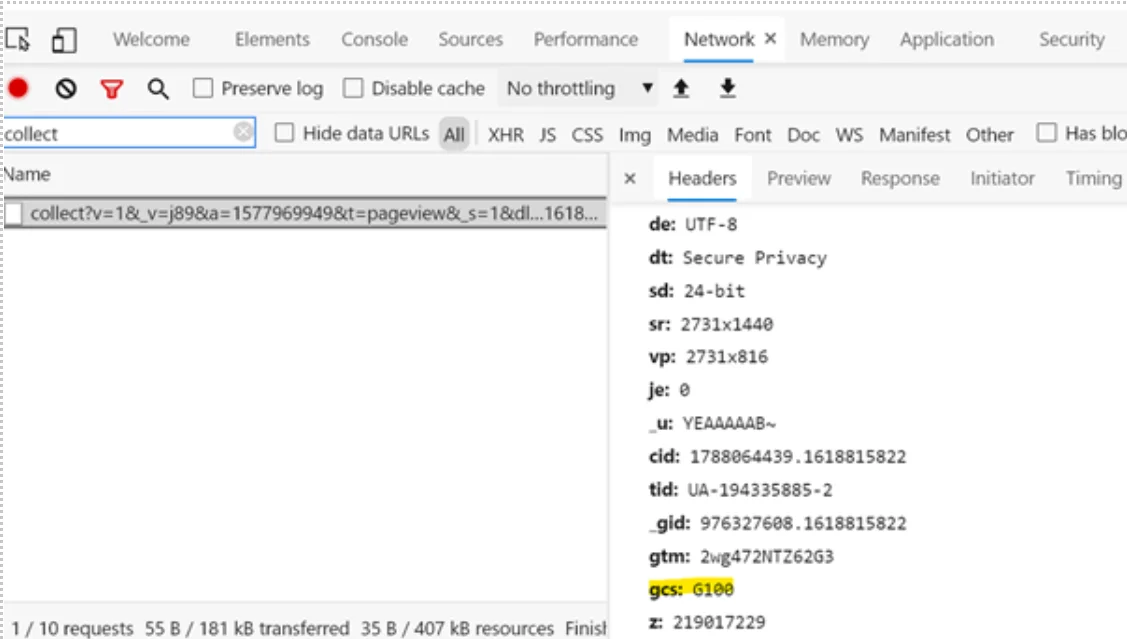
The gcs=G100 parameter in the collect request confirms Google Consent Mode is active and consent is currently Denied.
The highlighted gcs parameter with a value of G100 confirms that Google Consent Mode is active and the current consent state is Denied. No cookies will be set in this state.
Verifying Google Consent Mode After the User Grants Consent
Once a user provides consent via the Secure Privacy banner, Google Consent Mode updates its status to Granted. This triggers the following changes:
Cookies are created by Google Analytics and any other consented Google tags.
The next
collectAPI request will includegcs=G101(analytics consent granted) orgcs=G111(all consent types granted).
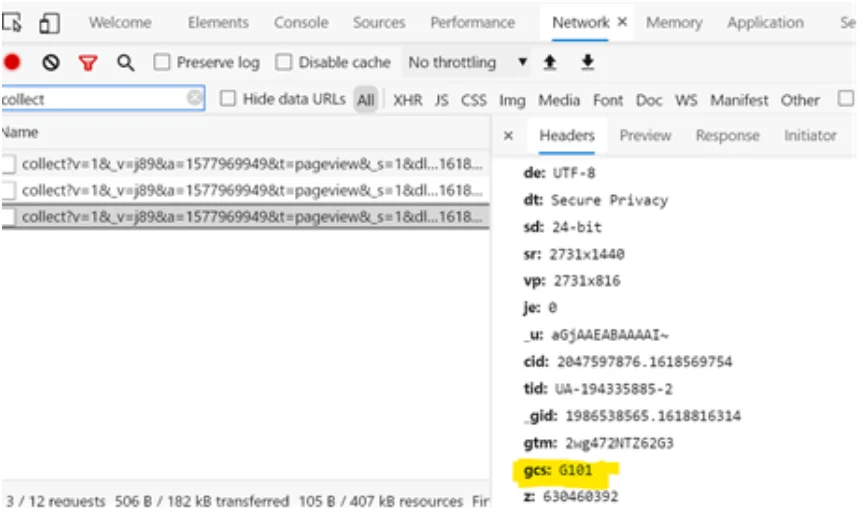
After the user grants consent, the gcs parameter updates to G101 or G111, confirming consent has been registered by Google Consent Mode.
Note: If you inspect a site without Google Consent Mode, you will only see the collect request after the user consents (when the script is loaded), and the gcs parameter will be absent entirely. The presence of gcs is your confirmation that Google Consent Mode is active.
Faster Verification: Consent Mode Inspector Browser Extension
For a quicker visual check of consent state without digging through DevTools, use the Consent Mode Inspector by InfoTrust. This Chrome extension displays the current Google Consent Mode state for all consent types at a glance directly in your browser toolbar.
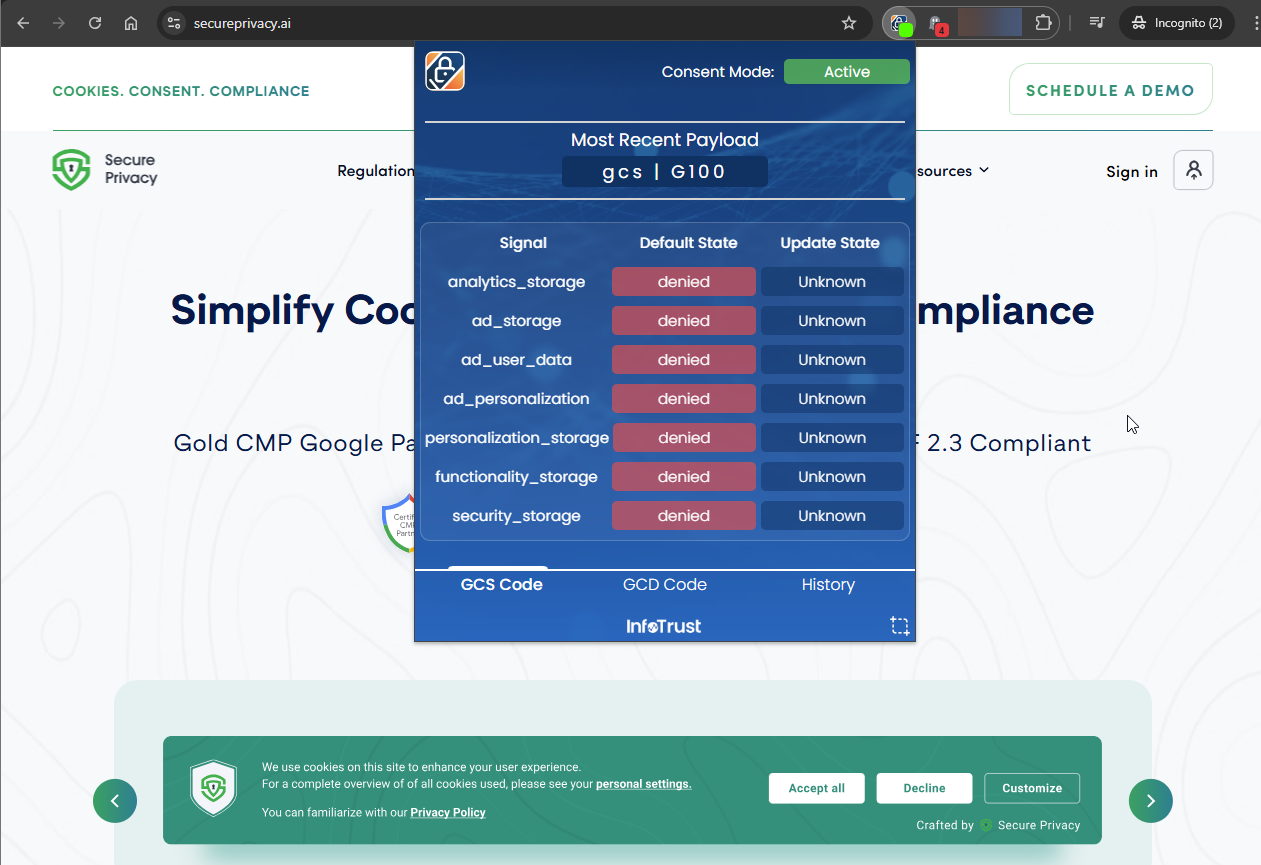
The Consent Mode Inspector by InfoTrust displays the live consent status for each category—a fast alternative to manual DevTools inspection.
Verifying Consent Mode Defaults via the dataLayer
Google Consent Mode defaults and subsequent consent updates are also logged directly in the dataLayer. You can inspect these in your browser console by entering:
window.parent.dataLayerThis will display the full history of consent events—including the initial default consent state set by your Secure Privacy configuration and any updates triggered by user interaction with the banner.
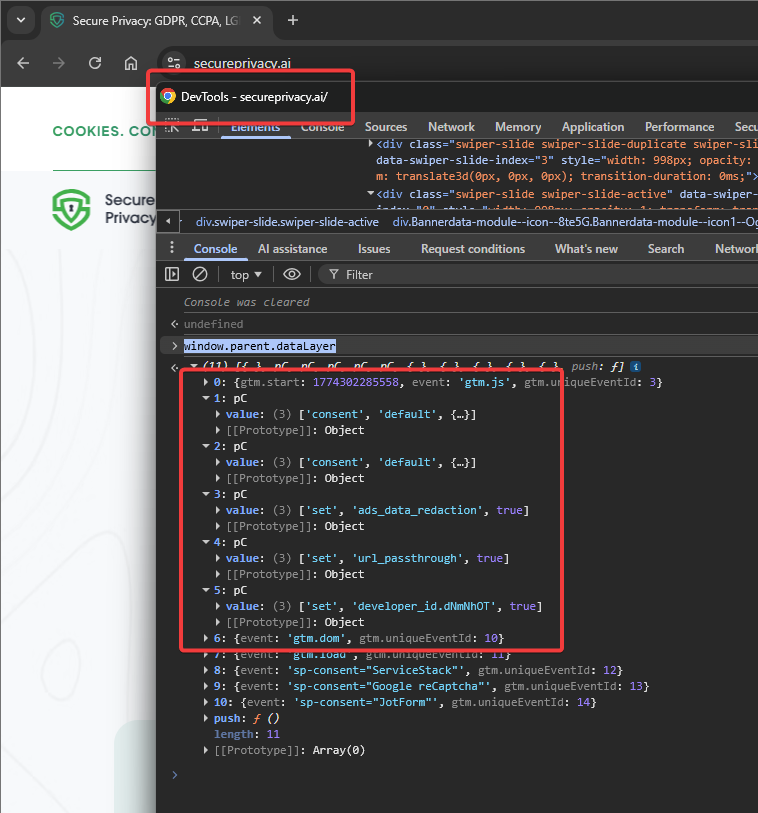
The window.parent.dataLayer console output showing Google Consent Mode default state and consent update events.
Frequently Asked Questions (FAQ)
How do I know if Google Consent Mode is working correctly?
Open Chrome DevTools, go to the Network tab, and filter for collect. If you see a collect request with a gcs parameter present, Google Consent Mode is active. A value of G100 means consent is denied; G101 or G111 means consent has been granted.
What does the gcs parameter mean in Google Analytics?
The gcs parameter is added by Google Consent Mode to every collect API request. It indicates the current consent state: G100 = Denied, G101 = Analytics Granted, G111 = All Granted. Its absence means Google Consent Mode is not implemented.
Why do I see a collect request even when the user hasn't consented?
This is expected behavior in Google Consent Mode (especially Advanced Mode). A cookieless "collect" ping is sent to enable conversion and behavioral modeling without setting cookies or identifying the user. This is different from a standard Google Analytics implementation, which only fires after consent.
What is the Consent Mode Inspector and how do I use it?
The Consent Mode Inspector by InfoTrust is a free Chrome browser extension that visually displays the current Google Consent Mode state for each consent category on any page. Install it, visit your site, and click the extension icon to see a live readout of granted and denied consent states.
How do I check consent mode events in the dataLayer?
Open your browser console and type window.parent.dataLayer. Look for consent events to see the default state set at initialization and any updates recorded after user interaction with your consent banner.
Need Further Assistance?
For additional help verifying your Google Consent Mode implementation, contact our support team at [email protected].
For urgent or systemic escalations related to Google Consent Mode, contact our designated point of contact: Andrew Sidorkin. We aim to address all escalations within one business day.
For policy questions directed to Google, contact the Google EU User Consent Policy team at [email protected].